Tell us about the job
Takes about a minute. No obligation.
A contractor diagnosing a central AC failure here has to work out whether the compressor gave out from use or from sitting. Homes in Day County, SD run cooling about two months a year, from July through August. Contactors corrode during a long idle, capacitors weaken without the cycling that would flag the problem, and refrigerant leaks that opened in September go unnoticed until the unit is called on again. The compressor itself rarely wears out from overwork on a schedule like this. What a technician finds on that first service call tells them more about how the unit was shut down and stored than about how hard it ran.
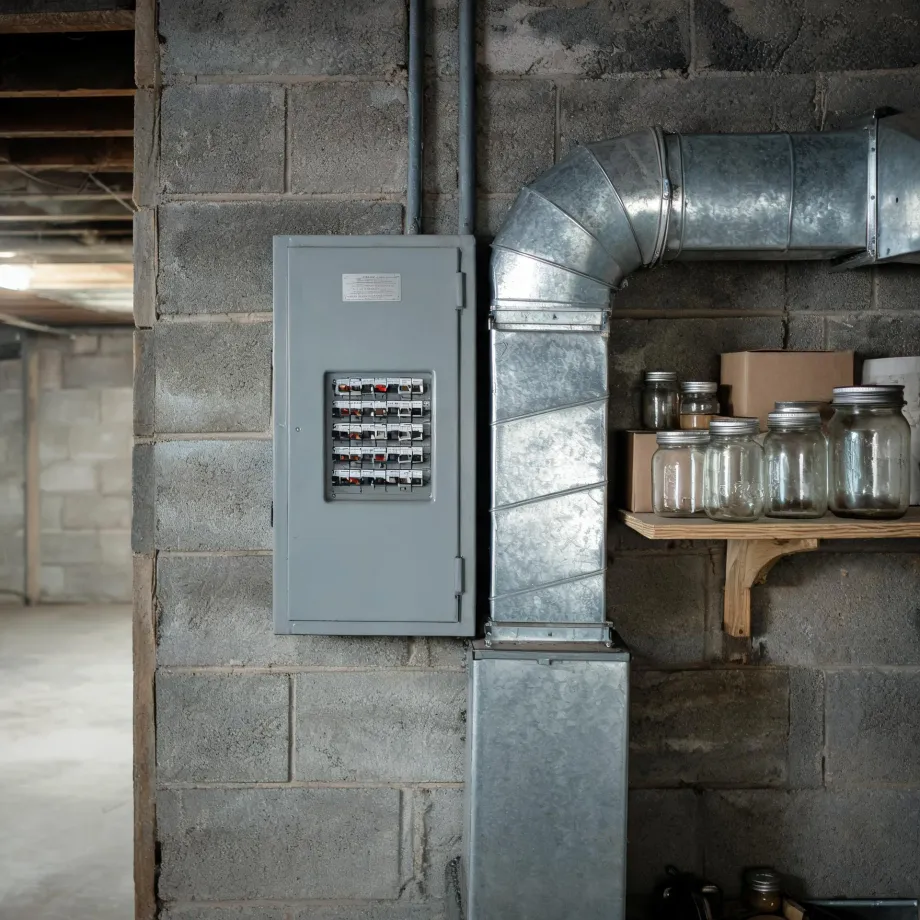
Ductwork routed for an earlier generation of equipment rarely lines up cleanly with what a central AC system needs now. Half the homes in Day County, South Dakota were built in 1967 or earlier (2020-2024 ACS 5-year). When a contractor opens a system here and finds the failed component, the surrounding infrastructure often adds its own complications: flex connections that have shifted, return paths that were undersized for the current unit, insulation around ducts that has lost integrity. Those findings change what the repair actually covers.
The Parts of a Central AC a Contractor Checks First
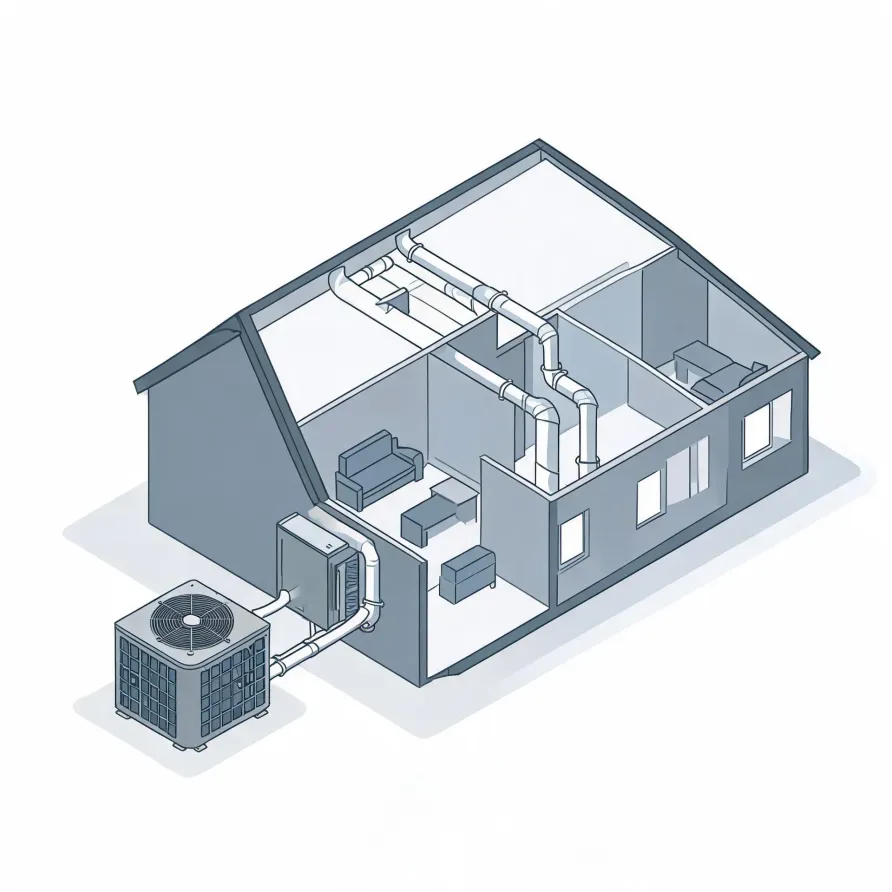
The outdoor condenser unit sits outside the house, usually on a concrete pad at ground level, and it is where heat pulled from inside the home gets released. The indoor air handler or furnace sits in a utility space, basement, or attic and pushes conditioned air through the home. When either stops doing its job, a contractor starts there.
The evaporator coil sits directly above the air handler and is where the system absorbs heat from indoor air. Refrigerant lines run between the indoor and outdoor units, and a metering device at the coil controls how refrigerant flows through the system. The thermostat on the wall is the last piece a contractor checks, since a wiring or calibration fault there can mimic a much larger problem.
The drawing shows the general layout of a central AC system, and a licensed contractor determines which components and conditions apply to your specific home.
Find a contractor in Day CountyDay County, South Dakota, by the numbers
198 severe weather events were recorded in Day County, South Dakota between 2015 and 2024.
NOAA National Centers for Environmental Information, Storm Events Database, bulk CSV export, events 2015-01-01 through 2024-12-31.Half the homes in Day County, South Dakota were built in 1967 or earlier (2020-2024 ACS 5-year).
U.S. Census Bureau, 2020-2024 American Community Survey 5-Year EstimatesDay County, South Dakota holds 3,440 housing units (2020-2024 ACS 5-year).
U.S. Census Bureau, 2020-2024 American Community Survey 5-Year EstimatesOwners occupy 74.6% of the occupied homes in Day County, South Dakota (2020-2024 ACS 5-year).
U.S. Census Bureau, 2020-2024 American Community Survey 5-Year EstimatesCodes & Standards for Central AC Repair in Day County, South Dakota8 sourced rules and standards
What happens when a contractor comes out for HVAC repair in Day County
Split-system central air conditioners rated below 45,000 Btu/h manufactured on or after January 1, 2023 must meet a federal minimum of 13.4 SEER2.
Split-system central air conditioners rated at or above 45,000 Btu/h manufactured on or after January 1, 2023 must meet a federal minimum of 13.4 SEER2.
Split-system central air conditioners manufactured between January 1, 2015 and December 31, 2022 had to meet 13 SEER, the metric that preceded SEER2.
Single-package central air conditioners manufactured on or after January 1, 2023 must meet a federal minimum of 13.4 SEER2.
Space-constrained central air conditioners manufactured on or after January 1, 2023 must meet a federal minimum of 11.7 SEER2.
Federal efficiency standards for split-system central air conditioners and heat pumps are set on each certified combination of outdoor unit and indoor coil rather than on the outdoor unit alone.
Residential and light commercial air conditioning and heat pump systems assembled in the field, including mini-splits and unitary systems, may not be installed on or after January 1, 2025 using a refrigerant with a global warming potential above 700.
A field-assembled system whose specified components were all manufactured or imported before January 1, 2025 carries no installation compliance date under the refrigerant restrictions and may still be installed.
Severe Weather Events in Day County
Extreme weather puts stress on cooling equipment, and that stress compounds over time. Repair needs in Day County track closely with what the local climate asks of a system, which is why the weather record belongs on a page about AC service here.
198 severe weather events, 2015–2024. Source: NOAA National Centers for Environmental Information, Storm Events Database.